

Hot forging begins by heating billets to a temperature where they readily deform under pressure. This heating process is performed using either gas or electricity. Although gas is a cheaper source of heat than electricity, that doesn’t necessarily translate into lower costs.
For forging companies, it’s critical to look at the overall process efficiency, and unit energy costs are only a small part of that. It’s also important to consider factors such as heat-up and soak times, as they can significantly impact throughput and lead time. Additionally, the chosen billet heating method affects surface quality and can have implications for internal grain flow and resistance to cracking.
Both gas and electricity heating methods have their use cases in manufacturing. In this article, we’ll discuss the benefits and limitations of each technology.
Gas Heaters
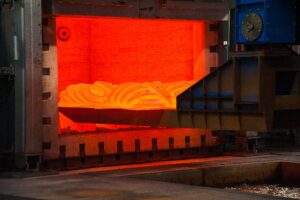
In traditional gas heating, billets are heated through conduction. The internal temperature is managed by placing thermocouples in the furnace to feed readings to a controller that adjusts gas consumption.
Gas furnaces can be either batch, where parts are placed inside and removed once up to temperature, or continuous. Continuous gas furnaces use either a walking beam or a pusher mechanism to move the billets through multiple heating zones.
Benefits
- Batch furnaces provide flexibility for small quantities.
- A well-established technology familiar to most maintenance personnel.
Limitations
- Creates oxidation and scale on the billet surface.
- Long soak times are needed to avoid significant temperature gradients within the billet.
- Billet temperature can only be maintained within a wide band.
- Furnace emissions require monitoring and control.
Are There Still Use Cases?
Gas has long been the default billet heating method, but is rapidly being supplanted by induction heating. However, there are still two primary use cases for using gas heating: 1) preheating small quantities of billets where surface finish, final strength, and precision are low priorities, and 2) preheating oversized billets that would require large induction coils and higher power levels.
Induction Heaters
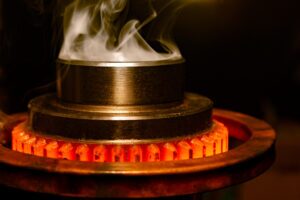
This heating technology uses the electromagnetic field generated by passing alternating current through a coil to heat a metal object inside the ring. The fluctuating electromagnetic field creates “Joule heating” in the billet by generating electric currents. In magnetizable materials, hysteresis heating can occur due to changes in the magnetic field.
The coil’s inner diameter should closely match the billet’s size. A higher fill factor increases efficiency, though production quantities and changeover times mean there’s a trade-off. Keeping to a limited range of coil sizes means slightly lower efficiency but fewer changeovers.
Induction heaters use high power (hundreds to thousands of kilowatts) to quickly bring metal parts up to the target temperature. Heating the whole billet rather than just the surface reduces surface-to-core and side-to-side temperature gradients and leads to more consistent forging. Electronic management of the induction coil or coils also enables very precise temperature control.
Induction heaters are available in both batch and continuous configurations. They don’t need exhaust systems as there is no combustion, although surface oils can form fumes as they evaporate.
Benefits
- Achieve uniform temperatures throughout the billet, which improves forging consistency and part strength.
- Produces smoother, cleaner surfaces than gas heaters.
- High-speed, high-throughput process suitable for large-quantity production but also efficient for short production runs.
- Highly efficient heat transfer mechanism.
- Minimal emissions issues.
Limitations
- Coil changeovers may be needed to maximize fill factor and efficiency.
- Sensitive to billet positioning within the coil (billet must be centered).
- Induction furnaces are more expensive to purchase and install.
Use Cases
Induction heating has become the preferred method for heating billets; the method is commonly used in:
- Applications where surface finish and appearance are priorities.
- Larger-quantity production runs.
- Applications requiring consistently high part quality.
- Small-to-medium-sized billets.
Why Trenton Forging Prefers Induction Heating
Trenton Forging switched to induction heating many years ago, and while it was a significant investment, we’ve seen firsthand that it results in higher-quality, more consistent forged parts and helps us achieve our goal of minimizing turnaround times.
Learn More About Our Process
Founded in 1967, Trenton Forging is a long-established, Michigan-based forging company dedicated to serving industries from automotive and agriculture to railroad and recreational vehicles. When you partner with us, you can expect responsive support, short lead times, and high-quality, near-net forgings.
Visit our website to learn more about our impression die forging and other in-house capabilities, or contact us today to discuss a project.