

Many industries rely on forging for their critical applications. When tight tolerances aren’t maintained during the forging process, it can result in dimensional variations, inconsistent wall thickness, and misaligned features, all of which can render parts unusable and lead to increased scrap rates, delays, and unnecessary additional costs. And for industries like automotive and defense, forged components must meet strict specifications; even minor deviations can compromise performance, safety, and compliance.
At Trenton Forging, we understand what’s at stake. That’s why precision isn’t just a goal—it’s built into every step of our impression die forging process.
Building Precise Tooling
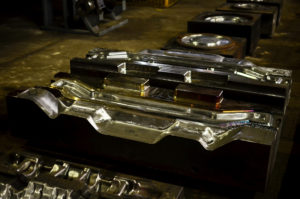
Impression die forging is done between two dies that come together to form a cavity the size and shape of the part being made.
The design of the upper and lower dies is key to producing quality precision parts. The two halves of the die must be engineered for consistent, repeatable alignment to minimize part-to-part dimensional variation. Re-entrant features and sharp changes of section should be avoided, and radii should be maximized to let the metal move where it’s needed.
Before moving into detailed die design, Trenton Forging’s engineering team uses SolidWorks, AutoCAD, and Creo Elements (Pro E), and Deform simulation software to create complete virtual representations of tooling to produce accurate physical prototype tooling before manufacturing begins. These models help identify potential design flaws and geometric problems that aren’t as apparent in 2D drawings and minimize the need for expensive trial-and-error approaches in tooling development. If customers already have existing tooling or need tooling reproduced or modified, we have contact and non-contact 3D laser scanners that allow us to verify and replicate 3D surfaces, regardless of complexity, and convert them into precise digital models.
Reducing Surface Imperfections With CNC Carbide Cold Saws
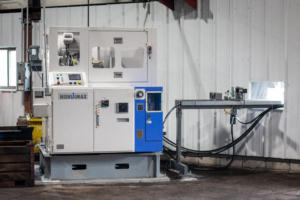
Trenton Forging has integrated CNC carbide cold saws into our process. In the past, the standard method was to use mechanical shears. While the process was quick, it inherently created burrs, distortion, and rough cut surfaces, resulting in work-hardened zones that affected forging behavior. CNC carbide saws produce cleaner, square cuts with minimal surface disturbance and virtually no burrs, all without sacrificing speed. Integrating these saws into our impression die forging process helps us ensure more consistent billet weights and dimensions across production runs, reducing the risks of surface irregularities and dimensional variations.
Practicing Precise Temperature Control With Induction Heating

Consistency is critical in forging, and induction heaters allow us to maintain this consistency. By using an induction heater, we reduce our energy use and maintain better temperature control during the forging process. Unlike furnace heating, induction heaters heat billets to exact temperatures quickly without thermal lag and maintain exceptional control throughout the process to minimize grain growth and preserve surface carbon content.
Investing in High-Quality Equipment

For many years, Trenton Forging relied on air-lift, gravity-drop hammer technology. While this technology remains highly efficient for low-volume orders, we recognized the need to modernize our processes. In 2022, we integrated the first fully automated 2500T mechanical press forging line into our process to maintain precision while manufacturing higher-volume programs and larger components.
Die Maintenance

Forging is a demanding process. Over time, tooling may need to undergo re-sinking to fix surface wear, cavity growth, surface cracking, and scaling. Trenton Forging has an in-house die maintenance facility that performs around 450 re-sinks annually. Re-sinking helps reduce operational costs for our customers and ensures we can maintain consistent quality in high-volume programs.
Thorough Testing
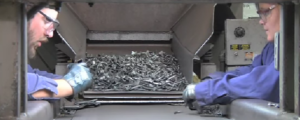
All forged components we produce are thoroughly tested in-house and through outside partners as needed. Our in-house testing capabilities include but are not limited to magnetic particle inspections, pull testing, hardness testing, 3D laser scanning, CMM, and hand inspections.
Get the Quality Forgings You Need Today
Since our founding over 50 years ago, Trenton Forging has been committed to delivering superior quality, exceptional service, and industry-leading turnaround times. We continually refine our processes with the latest technologies and sustainable practices to ensure we provide the precision our customers need for their critical applications.
Contact us today to learn more about our capabilities or to request a quote or first article sample.