

A Class 8 truck can easily cover 100,000 miles each year hauling a trailer between states. That’s a lot of failed road joints and potholes to hit, and a lot of stress on the suspension and drivetrain components that keep it moving. Other heavy-duty trucks might not travel as far, but if they’re used off-road, they can experience even higher loads and harder impacts on kingpins, ball studs, and other essential parts.
Engineering teams have to account for this use and abuse while simultaneously trying to meet challenging goals, including mass and size reduction. There’s no benefit to saving weight if durability suffers, though, which is why the materials and manufacturing methods chosen for these components are so important.
Custom forgings are often a better alternative to fabricated or cast metal parts in truck and trailer applications for several reasons, including:
1. Forging Creates Products With Unmatched Strength
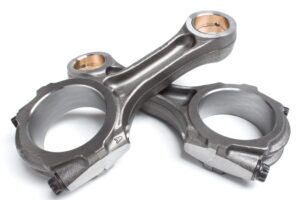
Strength isn’t just about the alloy chosen for a part or how it was heat-treated; the grain structure inside the alloy matters, too.
Rather than producing variably sized grains like the casting process, forging forces grains to flow perpendicular to the direction of compression, subsequently reducing the tendency for fatigue cracks to form and propagate, as well as internal defects like porosity. This makes the forging process far superior to casting for producing parts like pitman and steering arms, connecting rods, and other engine components that need significant compressive strength.
2. Forged Parts Exhibit Better Durability Under Pressure
Strength isn’t the only characteristic that matters in the truck and trailer industry—toughness is critical too. Tough components have higher impact resistance and a greater ability to withstand cycles of repetitive stress, which is obviously essential in truck and trailer applications.
The forging process improves toughness and durability in several ways:
- Through grain refinement, where coarse grains are broken into smaller ones that can accommodate deformation more uniformly.
- A flow pattern is created in the grain structure that follows the part’s contours and eliminates weak transverse grain boundaries that can cause premature failure.
- By closing voids and gas bubbles that would act as stress concentrators.
- By breaking up and redistributing brittle inclusions.
- By eliminating significant variations in grain size, which helps create more consistent properties.
3. Forging Supports Lightweighting
In the trucking industry, lightweighting matters. Every pound of weight you can eliminate when specifying a truck is another pound of payload capacity. Lightweighting allows trucks to carry more goods without exceeding limits, resulting in higher revenue for trucking companies. It also helps improve fuel efficiency, a significant variable expense for truckers.
Lightweighting is possible through forging primarily due to grain structure refinement, where cast structures are broken up uniformly. This allows engineers to use thinner cross-sections while maintaining the same strength.
4. The Forging Process Is Fast & Cost-Effective Over Time
Forging is a rapid, near-net shape process that produces low levels of material waste and requires almost no secondary machining. In comparison, machining is a slow method that generates significant waste and requires lengthy setups and post-processing procedures.
While impression die forging does require complex tooling, once that tooling is made, the production costs are relatively low. Machining has lower barriers to entry, but higher ongoing costs.
So, while the initial investment may seem higher, custom forgings help manufacturers save more money over larger quantity requirements.
Trenton Forging Keeps Trucks Moving
Trenton Forging is a proven leader in impression die forging. Since our founding in 1967, we’ve gained a reputation for our exceptional engineering capabilities, innovative thinking, and process mastery. When we help our customers in the truck and trailer industry, our goal is to manufacture products that achieve the highest possible levels of product strength and durability while still meeting application/design requirements. All products are made and tested in the United States.
In addition to forging, we offer value-added services, including in-house tooling and resinking, reverse engineering, machining, and rapid prototyping.
Visit our website to learn more about our company, or contact us today to request a quote or first article sample.