

The manufacturing process chosen for any given application matters because it influences cost, durability, and function of the final component.
Forging and CNC machining are often chosen for projects in which the final component is intended for use in demanding, high-load applications. Both processes have characteristics that make them beneficial in some situations, but create limitations in others.
This article compares both options, including benefits, limitations, and best use cases.
Impression Die Forging
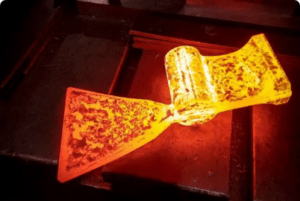
Forging refers to any process that compresses metal into a specific shape and is often categorized by the equipment used, the temperature at which the process is performed, and the type of tooling used (open versus impression). Impression die forging, in particular, is a repeatable process used to create complex shapes and involves squeezing the workpiece between tooling shaped to the required form.
Impression die forging is usually performed in three steps (edging, blocking, and finishing), where a hot billet is compressed and shaped to its final form. During this process, compression and deformation elongate the grains and make them flow with the metal, raising strength and toughness above that of the unforged material.
After forging, the metal part often undergoes heat treatment to optimize its mechanical properties. A limited amount of machining is usually needed to add high-precision features such as screw threads or to create very smooth surfaces.
Benefits
- Raises hardness and toughness above the level found in the unforged material
- By raising strength, can permit use of less metal or alloys with lower mechanical properties (which typically cost less)
- High-speed process
- Limited finishing work needed
- Very good part-to-part repeatability
Limitations
- Cannot form very fine detail and sharp edges (like screw threads and tight radii)
- As-forged surface finishes typically in the range of 125-500 μin Ra, with finer finishes requiring subsequent machining
- Tooling can be expensive and time-consuming to make
- Geometry of the part being forged is limited to what a pair of opposed dies can achieve (no recesses, some draft angles needed)
Best Applications
- Parts requiring high strength and toughness, such as shafts, suspension components, and connecting rods
- Components of construction and agricultural equipment, like pivot arms and hydraulic cylinder ends
- Military/defense equipment components
- Gear blanks (where high toughness is paramount)
- Parts needed in large quantities, like those used in the automotive industry
CNC Machining
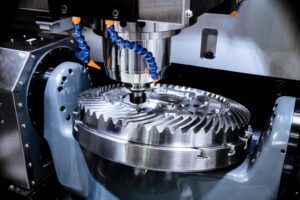
Machining involves cutting material from a solid metal billet to produce the required shape. It’s usually done by milling, where a rotating, multi-toothed cutter moves over the metal part to remove material and form flat faces, slots, pockets, and contoured surfaces. Curved and 3D surfaces can be milled on standard 3-axis machines using ball-nose cutters, while more advanced 5-axis tools add the ability to create undercuts or machine multiple faces in a single setup.
Milling is often followed by drilling to produce narrow holes, as needed for bolts or for fluid passages, and very smooth surfaces are formed by grinding. Some parts may also be turned on a lathe to create cylindrical features, such as shafts and bores, as needed for bearings and seals.
One challenge in machining is clamping the part securely so it doesn’t move. Most parts will require several machining operations, with the part reoriented and possibly moved to a different machine between operations, which can introduce dimensional variation.
A second issue is that cutting tools can wear, especially on harder and more abrasive materials. This affects both surface finish and the dimensions achieved. Machining tough materials can require machine tools with very high stiffness and power and torque capabilities.
Benefits
- Can create complex forms and smooth surfaces, and maintain tight tolerances
- Needs very little special-purpose tooling (dedicated fixtures may be needed to hold some parts for machining)
- Very little initial lead time; first sample parts can be produced within a few days, often faster
Limitations
- Grain structure remains as it is in billet form, which, depending on how the part is machined, can lead to features with low strength
- Complex features requiring significant metal removal, like deep pockets, can take a lot of time to cut
- Can generate a significant amount of material waste when a part design calls for large holes and pockets
Best Applications
- Small quantity production, such as parts for test fixtures or specialist industrial equipment
- When parts are needed quickly, as for samples and prototypes
- Parts with complex geometries like those used in medical devices and aerospace
- Parts needing very high accuracy and smooth surfaces, like those used in hydraulic valves and pumps
See if Forging Is Right for Your Application
Impression die forging has many benefits, but it doesn’t work for every application. There can be situations where CNC machining may provide advantages, particularly when quantities are low and/or an expedited timeline is required.
Trenton Forging is a trusted, U.S.-based impression die forging company with nearly six decades of experience producing high-strength, near-net asymmetrical and symmetrical components. Beyond forging, we provide value-added capabilities, including reverse engineering, CNC machining for rapid prototypes, and die resinking to increase the lifespan of our tooling.
Contact us today with more details about your project. We can provide a project analysis and a first article sample to help you determine whether forging is the right process for your project.