

The forging process is known for producing durable components with exceptional fatigue strength and impact resistance. However, these components can have rougher surfaces and, depending on surface finish requirements, may need shot blasting, CNC machining, or other secondary processes.
Typical Ra values in forging range from 3 to 12 μm, where 3 feels smooth and has a matte gray appearance and 12 feels coarse and has a distinct texture. A variety of factors ultimately impact the as-forged surface finish, with well-controlled processes featuring an upper limit closer to 6 μm.
Oxidation & Scale
Most metals develop an oxide layer as their surface molecules bind to oxygen. If this layer develops, it will grow deeper into the material and eventually form scale that flakes away. With some alloys, this can lead to a significant reduction in metal mass and difficulty in maintaining required dimensional tolerances. It also increases surface roughness through material removal and how scale is pressed into the hot surface during forging.
Additionally, scale particles, which tend to be hard and abrasive, can mark the inner surfaces of the tooling, causing a further reduction in surface quality. If not removed from the forged part, they will accelerate tool wear during any subsequent machining operations.
Trenton Forging reduces oxidation and scale in two ways: 1) Through careful control of the temperature and heating duration during the forging process to inhibit oxidation formation, and 2) Providing post-forging shot blasting to remove scale.
Temperature & Heating Method
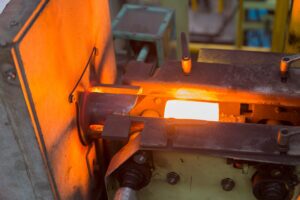
Oxide layers can form on steel once temperatures reach roughly above 570°C (1,058°F), and the rate at which oxidation and scale form continue to climb as temperatures rise. Because hot forging is performed well within this range, careful process control is required to prevent significant scale development.
Temperature also affects how metal flows under compression. Lower temperatures cause poor flow and surface tearing. When hotter, it flows more readily around the die, although this can create more oxide.
Optimal heating, and hence surface roughness reduction, requires careful control of billet heating. The ideal approach is to heat the billet uniformly rather than relying on conduction to transfer it from the outside.
Trenton Forging uses advanced induction heating systems rather than the traditional gas-fired approach to achieve the ideal temperature without promoting high levels of oxide growth.
Type & Quality of Materials Being Forged

Oxidation is strongly influenced by alloy composition. In particular, chromium slows oxidation dramatically by forming a chromium oxide layer on the surface. This is why stainless steels (with a minimum of 10.5% chromium) suffer from less oxidation than carbon steels.
It’s important to use high-quality stock for the billets used in forging because it reduces part-to-part variation and minimizes the presence of any impurities or internal defects. To achieve this, Trenton Forging works with a trusted network of steel mills that consistently deliver high-quality raw material.
Tooling Design & Condition
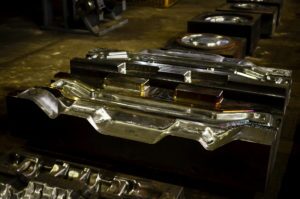
Compression dies play an important role in lowering roughness and avoiding surface defects. Die surfaces must be extremely smooth to support good metal flow and avoid transferring texture to the part being forged. They must also align precisely to minimize parting line formation.
Scale resulting from oxidation will mark die surfaces. While this can be minimized through careful and accurate temperature control, it’s never completely avoidable. Resinking (maintaining) the tooling used in forging helps reduce defects, and that’s why Trenton Forging maintains an in-house facility dedicated to resinking.
Blank Preparation
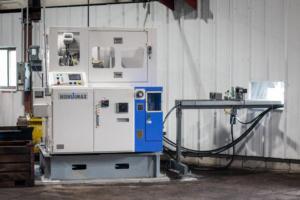
Poor control over the billet cutting process leads to:
- Burrs: These surface defects can get folded into the metal during compression, creating surface laps or seams. And with a larger surface area-to-volume ratio, burrs will oxidize faster than the main body of the material.
- Billets of Varying Length: Differences in material volume cause part-to-part variation in flow during compression, increasing the risk of surface defects.
- Non-Square Cuts/Non-Flat Ends: Also lead to more variation during compression, contributing to increased surface roughness and defects.
Trenton Forging reduces surface defect risks by investing in CNC carbide saws, which produce cleaner, more consistent cuts with fewer burrs.
Process Speed
Hot impression die forging can be performed with presses or hammers. Presses provide a longer contact period and slower deformation, which can affect surface finish.
More billet-to-die contact time means more cooling, and more time for oxides to form. There’s also an increased possibility of metal sticking to the dies. However, going too fast increases the risk of cracking, trapped air, and incomplete die filling.
Optimizing process speed to achieve the highest levels of surface finish and quality is a complex task closely linked to die design. As Trenton Forging uses both press and hammer methods, we select the most appropriate technology and design forged parts and dies in ways that prevent defects and meet customer requirements.
Learn More From Trenton Forging
Trenton Forging has been a leading U.S.-based impression die forging manufacturer since 1967. We know that producing high-quality forged parts for demanding applications requires experience and advanced production technology. Since our founding, we’ve been committed to continuous improvement, and investing in induction heaters, an in-house die maintenance department, and CNC technology are just some of the ways we’ve improved our processes to achieve the highest possible levels of quality.
Visit our website to learn more about impression die forging, or contact us today to request a project analysis and quote.