

The term “forging” covers a range of manufacturing processes where a metal blank is shaped under pressure. Hammer forging may be the oldest variant, but today, impression die forging has the widest industrial use.
The impression die forging process leaves a metal lip around the perimeter of the part where the two dies meet, called flash. This flash is an important part of the process, but it must be trimmed away afterward. Flash raises pressure inside the die, forcing metal into the extremities to produce near-net parts with minimal defects.
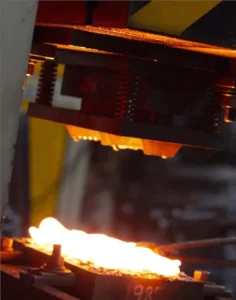
Flashless forging is a modified version of impression die forging that avoids this lip. While eliminating the trimming operation sounds desirable, trade-offs are necessary. As a result, flashless makes sense in some use cases, while conventional impression die forging is better in others.
The Impression Die Forging Process
The “impression” in impression die forging refers to the shaped cavities in the upper and lower dies. Multiple sets are used to progressively deform and shape a billet into the required geometry.
There are three primary stages to impression die forging: busting, blocking, and finishing. During the busting stage, the billet is shaped into a preform, or the general shape of the end part. The blocking stage creates the near-net shape of the part, but features steep draft angles, large radii, and lacks fine detail. During this stage, flash forms around the parting line between the upper and lower dies. The final stage completes part formation by tightening radii, reducing draft to the specified angle, and adding fine details.
Benefits
Conventional impression die forging is a fast process that yields strong near-net parts, and can be used to manufacture products with complex forms, tight radii, and thin sections.
Although there is an initial investment in tooling, dies can last thousands of parts and be refurbished periodically to extend their lifespan, ultimately producing exceptional ROI for high-volume projects.
Limitations
The major limitations relate to flash, which must be removed in a trimming operation but can still leave a visible line around the part periphery.
Flash can account for 30% or more of the total billet weight. While recycling is part of the process, it means more metal needs heating, which adds more cost.
Additionally, machining allowances are required to accommodate variation, which increases the amount of metal removal work.
The Flashless Forging Process
In flashless forging, no metal is allowed to escape the dies as they close. To achieve this, billets must be sized precisely to fit the die cavity and heated to a narrow temperature range to avoid differences in thermal expansion.
As the dies close around the billet, they enclose it completely with no flash land, although some allowance is needed to let air escape.
Tool complexity means the process is generally used on simpler parts, such as gears and other rounds, where metal flow and volume distribution are predictable enough to fill the cavity exactly.
Benefits
The trimming process is eliminated, which means there is no flash line on the finished part. Flashless forged parts can be produced to tighter tolerances; draft angles are smaller, radii can be tighter, and surface finish is typically smoother. The process enables smaller machining allowances, providing additional cost savings.
Limitations
Flashless forging requires tight control over the billet cutting process to ensure each piece is exactly the required volume. The process also requires precise heating to eliminate size differences due to thermal expansion.
The tooling used in flashless forging can suffer higher rates of cracking due to increased loads and can wear faster than those used in conventional impression die forging. Consequently, the tooling cost per piece produced is usually higher.
When Impression Die Is the Most Cost-Effective Solution
While the material cost savings and possible reduction in machining of flashless forging are attractive, they are often outweighed by its disadvantages. Impression die forging is more cost-effective because it is more tolerant of billet variation and tool life is longer.
The exceptions, when flashless can have the edge, occur mainly when forging high-value materials and the flash is a high percentage of total billet weight. In some situations, particularly when forging alloys with low machinability, the reduction of machining can also factor into the calculation.
See If Impression Die Forging Is Right for Your Project
Founded in 1967, Trenton Forging is a leading, U.S.-based manufacturer specializing in impression die forging. We manufacture asymmetrical and symmetrical parts from carbon, alloy, and stainless steel for many industries, including defense, automotive, and transportation. We work with our customers to understand their needs and provide in-house modeling and tooling development to engineer the exact die shapes parts require.
If you have a part that needs forging, contact us today to request a project analysis and see if impression die forging is the right method for your project.