

There isn’t one universal forging process. It can be categorized by how force is applied (e.g. hammer versus press), process temperature, and by the tooling used (open die and impression die).
In open die forging, the workpiece is shaped between flat or simple dies that don’t enclose it, and compressed with hammers or presses. In impression die forging, the billet is hammered or pressed into shaped cavities that are machined into the tooling, often in several progressive stages.
Each process has its place. Open die forging needs little tooling and is the standard method for large, relatively simple parts. However, it can’t produce complex geometries without extensive machining and defect-free results depend more on operator skill.
Common Forging Defects
- Laps & Folds: When metal folds back on itself without a solid bond.
- Cracks: Often seen around corners and can result from excessive deformation.
- Underfilling: Where metal didn’t flow as needed, resulting in an incomplete part.
- Incorrect Grain Flow: When grain orientation doesn’t align with the primary load paths.
All of these defects are largely preventable in impression die forging (with good die design) because:
- The metal flow is predictable and repeatable from part to part.
- Flash restriction at the parting line creates back pressure that helps fill the die cavity.
- The workpiece is largely under compressive stress during deformation, which helps close voids and suppress cracking.
- The grain flow follows the part contour, and the near-net shape means little machining is required.
Predictable Metal Flow
Metal flow is the major reason forging creates stronger metal shapes compared to processes like casting or machining from solid. As the metal deforms, its internal structure is refined, and inclusions, segregation, and second-phase particles are drawn out in the direction of flow.
In impression die forging, the billet is shaped in multiple stages, with the number of stages determined by part complexity. A typical forging sequence involves preforming, where the billet is shaped to the general form needed; blocking, where the general shape is formed with wider radii; and finishing, where draft is reduced, radii is tightened, and fine details are added.
Because every billet follows the same sequence, the process is highly repeatable.
In open die forging, the workpiece is shaped through a series of upsetting blows, and the billet is rotated between strikes. There is less control over how metal moves into complex shapes, so part-to-part consistency is lower, and there’s a potential risk of defects like laps, folds, and cracks.
Flashing Regulates Pressure
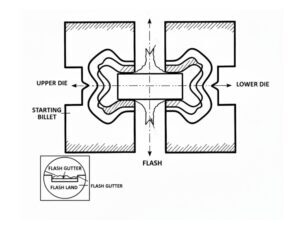
Impression die forging can create complex details like ribs, webs, and concave radii in forged parts (something that can’t be accomplished through open die forging). This is because the tooling used in impression die forging is machined to form the shapes needed, and flash (excess metal) is used to control how the cavity fills.
Impression die tooling has two distinct features: a flash land and flash gutters. The flash land restricts outward flow of excess material and allows back pressure to build up and force metal into the deepest, most detailed parts of the cavity, while the flash gutter allows the excess material to escape unrestricted so the flash doesn’t build up and hold the dies apart. Both design details help minimize the occurrence of underfilling-related defects.
Compressive Stress During Deformation
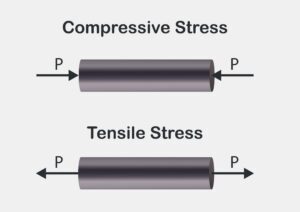
In impression die forging, the die walls confine the metal as it deforms, putting the metal billet into a triaxial compressive stress state. Under these conditions, metal can undergo large deformations without cracking, and small internal voids are pressed closed, helping produce consistently higher-quality complex parts.
In open die forging, free surfaces can develop tensile stresses during deformation, raising the risk of surface cracking, especially in less ductile alloys.
Grain Flow Follows Part Contour
Because metal flows into the shape of the machined die cavity, grain flow follows the part’s contour. The produced part is near-net, so machining is usually limited to functional surfaces, holes, and tight-tolerance features, which helps preserve most of the grain flow.
When open die forging is used for complex parts, machining is needed to reach the final geometry, and that machining cuts across the grain flow and exposes end grain at the surface. Exposed end grain lowers fatigue resistance and enables stress corrosion in some metals. Heavy machining can also cause distortion because removing material releases and rebalances residual stresses in the part.
With good die design, impression die forging does a better job of producing complex shapes with grain flow aligned to the part’s load paths, resulting in stronger, more dependable parts that are far less likely to fail in service.
Learn More About Impression Die Forging
Founded in 1967, Trenton Forging specializes in producing complex symmetrical and asymmetrical parts through impression die forging. All processes are performed in-house in our Michigan-based facility. Our capabilities include 3D laser scanning/reverse engineering, tooling design and maintenance, and machining. To maintain quality throughout the forging process, we use CNC carbide saws to minimize surface imperfections and induction heating to maintain precise temperature control, prevent defects, and ensure part-to-part consistency.
Visit our website to learn more about our forging process, or contact us today to see if impression die forging is the right solution for your project.